Published June 24, 2026
Essential Insurance Policies Every First-Time Homebuyer Needs to Know About

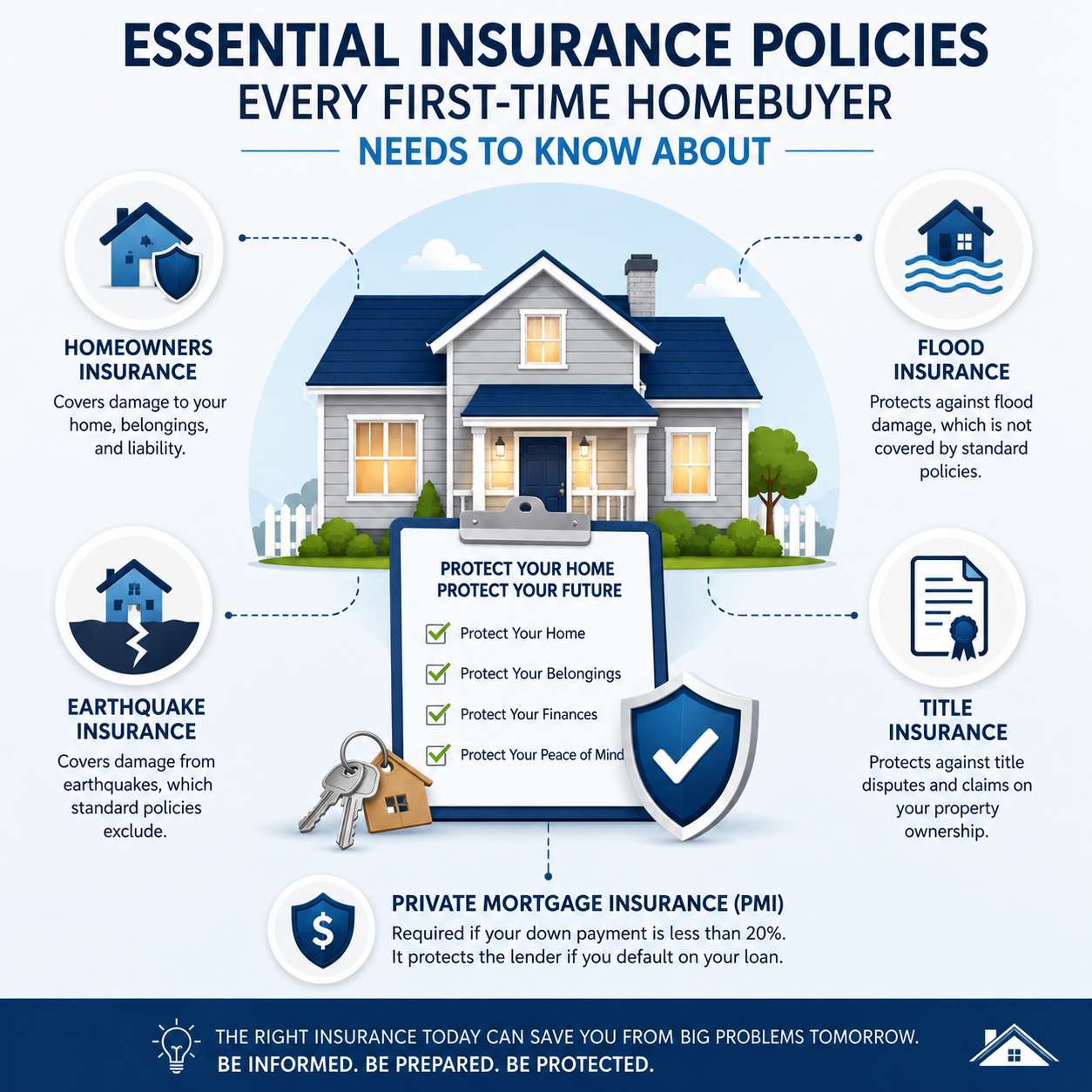
Buying your first home is one of the most exciting milestones in life. After months of searching, saving, and signing paperwork, you finally have a place to call your own. But the responsibilities that come with homeownership extend well beyond making your mortgage payment on time. One of the most important, and often overlooked, aspects of protecting your investment is understanding the insurance policies you need from day one.
Many first-time homebuyers are surprised to learn that a standard homeowners insurance policy does not cover every possible risk. From floods to title disputes, there are gaps that can leave you financially exposed if you are not prepared. This guide walks you through the essential insurance policies every new homeowner should understand, so you can protect your home, your finances, and your peace of mind.
Section 1: Homeowners Insurance, The Foundation of Your Coverage
Homeowners insurance is the cornerstone of any smart protection strategy, and in most cases, your mortgage lender will require you to have it before you close on your home. But understanding what it actually covers is just as important as having it.
A standard homeowners insurance policy typically includes four core types of coverage. The first is dwelling coverage, which pays to repair or rebuild the structure of your home if it is damaged by a covered event such as fire, windstorm, hail, or vandalism. The second is personal property coverage, which protects your furniture, electronics, clothing, and other belongings inside the home. The third is liability protection, which covers you if someone is injured on your property and decides to sue. The fourth is additional living expenses, which pays for temporary housing and meals if your home becomes uninhabitable after a covered loss.
What homeowners insurance typically does not cover is just as important to know. Most standard policies exclude flood damage, earthquake damage, and general wear and tear. Mold, pest infestations, and sewer backups are also commonly excluded unless you add specific riders to your policy.
When shopping for homeowners insurance, pay close attention to whether your policy covers replacement cost or actual cash value. Replacement cost pays what it would cost to rebuild or replace your belongings at today's prices. Actual cash value pays out after factoring in depreciation, which can leave you significantly short when it comes time to file a claim.
Take the time to review your coverage limits carefully. Many first-time buyers underinsure their homes because they base their coverage on the purchase price rather than the cost to rebuild. These are two very different numbers, and getting them confused can be a costly mistake.
Section 2: Flood and Earthquake Insurance, Covering What Standard Policies Miss
One of the biggest misconceptions among first-time homebuyers is assuming that their homeowners policy will cover any disaster that affects the home. In reality, two of the most financially devastating types of damage, floods and earthquakes, are explicitly excluded from standard policies. If you live in a region prone to either of these events, purchasing separate coverage is not optional; it is essential.
Flood Insurance
Flooding is the most common and costly natural disaster in the United States. Even if you do not live in a high-risk flood zone, nearly 40 percent of flood claims come from properties in moderate-to-low risk areas. Heavy rainfall, overflowing rivers, and storm drainage failures can cause flooding in neighborhoods that have never experienced it before.
The primary source of flood insurance for most homeowners is the National Flood Insurance Program (NFIP), which is administered by the Federal Emergency Management Agency (FEMA). NFIP policies cover up to $250,000 for the building structure and up to $100,000 for personal contents. Private flood insurance options are also available and may offer higher coverage limits or broader terms depending on your location.
If your home is located in a Special Flood Hazard Area, your lender will likely require flood insurance as a condition of your mortgage. But even if it is not required, it is worth evaluating your risk carefully. A single flood event can cause tens of thousands of dollars in damage that your homeowners policy will not touch.
Earthquake Insurance
Earthquake insurance is another separate policy that covers damage caused by seismic activity. While it is most commonly associated with states like California, Oregon, and Washington, earthquakes can and do occur in many other regions of the country. Standard homeowners policies almost universally exclude earthquake damage.
Earthquake policies typically cover structural damage to the home, personal property loss, and additional living expenses if you are displaced. However, these policies usually come with a high deductible, often between 10 and 20 percent of your home's insured value, so they are best suited for covering major losses rather than minor tremors.
Section 3: Title Insurance and Private Mortgage Insurance, Two Policies You Cannot Ignore
Beyond property damage coverage, two other critical insurance products play a major role in protecting your financial interests as a homebuyer: title insurance and private mortgage insurance (PMI). These policies serve very different purposes, but both deserve a thorough understanding before you close on your home.
Title Insurance
When you purchase a home, you are not just buying the physical structure. You are also acquiring the legal ownership of that property, and that ownership can be contested. Title insurance protects you against claims or disputes arising from problems with the property's title, including undisclosed liens, forged documents, clerical errors in public records, undisclosed heirs, or boundary disputes.
There are two types of title insurance. The lender's policy protects your mortgage lender's financial interest in the property and is almost always required. The owner's policy protects your personal investment and is typically optional, though highly recommended.
Title problems are more common than most buyers expect. An unresolved lien from a previous owner's unpaid contractor or a mistake in the county records can surface years after you move in. Title insurance is a one-time premium paid at closing, and it provides coverage for as long as you own the property. Given the potential costs of a title dispute, it is one of the best values in real estate protection.
Reputable providers in this space, such as AIM Insurance, emphasize the importance of thoroughly vetting the property's title history before finalizing coverage, so homeowners are fully informed of any risks before they arise.
Private Mortgage Insurance (PMI)
If your down payment is less than 20 percent of the home's purchase price, your lender will almost certainly require you to carry private mortgage insurance. Unlike other policies on this list, PMI is designed to protect the lender, not you. It kicks in if you default on your loan, reimbursing the lender for a portion of the loss.
That said, understanding PMI is important because it directly affects your monthly payment. PMI typically costs between 0.2 and 2 percent of the original loan amount per year, depending on your loan type and credit profile. On a $300,000 mortgage, that could mean an extra $50 to $500 per month added to your payment.
The good news is that PMI is not permanent. Once you reach 20 percent equity in your home, you can request that your lender cancel it. Under the Homeowners Protection Act, lenders are required to automatically cancel PMI once you reach 22 percent equity based on your original payment schedule.
Section 4: Additional Policies Worth Considering
Once you have your foundational coverage in place, there are several additional insurance products that can further strengthen your protection depending on your specific situation.
Umbrella Insurance
An umbrella insurance policy provides additional liability coverage beyond the limits of your homeowners policy. If someone is seriously injured on your property and sues you for an amount that exceeds your homeowners liability limit, an umbrella policy steps in to cover the difference. Umbrella policies are relatively affordable, typically starting at around $150 to $300 per year for $1 million in additional coverage, making them an excellent value for the peace of mind they provide.
Home Warranty
While not technically insurance, a home warranty is worth mentioning because it fills a gap that insurance does not cover. Homeowners insurance protects against sudden, accidental damage; a home warranty covers the breakdown of major systems and appliances due to normal wear and tear. This includes your HVAC system, plumbing, electrical systems, refrigerators, dishwashers, and more.
For first-time buyers purchasing an older home, a home warranty can save thousands of dollars in repair and replacement costs during those critical first years of ownership.
Scheduled Personal Property Endorsements
If you own high-value items such as jewelry, art, collectibles, or musical instruments, the standard personal property coverage in your homeowners policy may not be enough. A scheduled personal property endorsement allows you to insure these items individually at their full appraised value, with broader coverage than your base policy provides.
Conclusion: Protect Your Investment from Day One
Becoming a homeowner is a major accomplishment, and protecting that investment should be a top priority from the moment you sign the closing documents. The world of home insurance can feel overwhelming at first, but understanding the purpose of each policy makes the decision-making process much more manageable.
Start with a comprehensive homeowners insurance policy and make sure your coverage limits reflect the true cost of rebuilding your home. Evaluate your need for flood and earthquake insurance based on your location and risk profile. Understand the terms of your title insurance and PMI before closing. Then consider whether umbrella insurance or a home warranty makes sense for your situation.